
This is a follow-up to:
This post enables the Backstage Kubernetes view without changing any Backstage source code and without installing any extra plugin. We only add Kubernetes-side configuration:
- Add Backstage Kubernetes plugin config (in
app-config.k8s.yaml) - Create a read-only ServiceAccount + RBAC for Backstage to read cluster objects, events, logs, and metrics
- Map the Component to Kubernetes objects using
backstage.io/kubernetes-id - Label the Kubernetes objects with the same
backstage.io/kubernetes-idso they show up under the Component
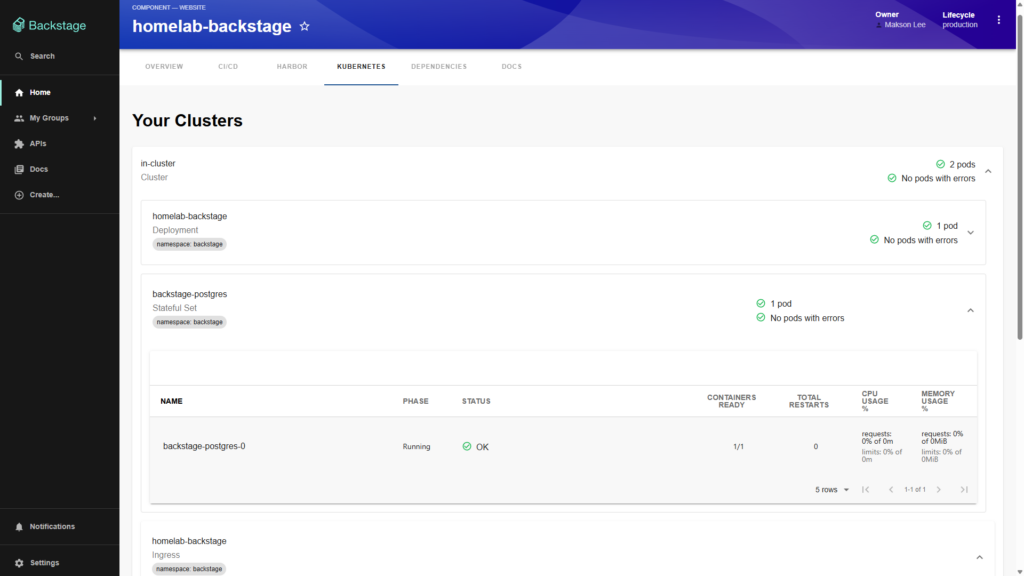
What you get in the UI
Inside the homelab-backstage Component page → Kubernetes tab:
- Deployments / Pods
- Services / Ingress
- Events
- Pod logs
- Pod + node metrics (if Metrics Server is available)
- Map the Backstage Component to Kubernetes objects (Catalog annotations)
Update your Component entity so Backstage knows which cluster, which namespace, and which kubernetes-id to query.
catalog-info.yaml
diff --git a/catalog-info.yaml b/catalog-info.yaml
index a8abe33..164d342 100644
--- a/catalog-info.yaml
+++ b/catalog-info.yaml
@@ -8,7 +8,9 @@ metadata:
     jenkins.io/job-full-name: backstage/homelab-backstage-main-ci
     backstage.io/techdocs-ref: dir:.
     harbor.maksonlee.com/repository: backstage/homelab-backstage
-
+    backstage.io/kubernetes-id: homelab-backstage
+    backstage.io/kubernetes-namespace: backstage
+    backstage.io/kubernetes-cluster: in-cluster
 spec:
   type: website
owner: user:default/maksonlee- Add Kubernetes plugin config (in-cluster)
Backstage needs to know how to locate clusters and how to authenticate. Here we use:
serviceLocatorMethod: multiTenantclusterLocatorMethods: configwith a single clusterin-clusterauthProvider: serviceAccountso it uses the Pod’s ServiceAccount token automatically
kubernetes/app-config.k8s.yaml
diff --git a/kubernetes/app-config.k8s.yaml b/kubernetes/app-config.k8s.yaml
index 3feca55..04d5aa4 100644
--- a/kubernetes/app-config.k8s.yaml
+++ b/kubernetes/app-config.k8s.yaml
@@ -7,3 +7,16 @@ backend:
   cors:
     origin: https://backstage-k8s.maksonlee.com
     credentials: true
+
+kubernetes:
+  serviceLocatorMethod:
+    type: multiTenant
+
+  clusterLocatorMethods:
+    - type: config
+      clusters:
+        - name: in-cluster
+          url: https://kubernetes.default.svc
+          authProvider: serviceAccount
+          skipTLSVerify: false
+ skipMetricsLookup: false- Grant Backstage read-only access to Kubernetes (RBAC)
The Kubernetes tab can show more than just Deployments/Pods; common “extra info” includes:
- Events
- Pod logs
- Pod + node metrics (from
metrics.k8s.io)
So we add a read-only ServiceAccount and RBAC.
kubernetes/backstage-k8s-rbac.yaml (new file)
diff --git a/kubernetes/backstage-k8s-rbac.yaml b/kubernetes/backstage-k8s-rbac.yaml
new file mode 100644
index 0000000..05c4034
--- /dev/null
+++ b/kubernetes/backstage-k8s-rbac.yaml
@@ -0,0 +1,47 @@
+apiVersion: v1
+kind: ServiceAccount
+metadata:
+  name: backstage-k8s-reader
+  namespace: backstage
+---
+apiVersion: rbac.authorization.k8s.io/v1
+kind: ClusterRole
+metadata:
+  name: backstage-k8s-readonly
+rules:
+  - apiGroups: ['', 'apps', 'batch', 'autoscaling', 'networking.k8s.io']
+    resources:
+      - namespaces
+      - pods
+      - pods/log
+      - services
+      - endpoints
+      - configmaps
+      - limitranges
+      - resourcequotas
+      - deployments
+      - replicasets
+      - daemonsets
+      - statefulsets
+      - jobs
+      - cronjobs
+      - horizontalpodautoscalers
+      - ingresses
+      - events
+    verbs: ['get', 'list', 'watch']
+  - apiGroups: ['metrics.k8s.io']
+    resources: ['pods', 'nodes']
+    verbs: ['get', 'list']
+---
+apiVersion: rbac.authorization.k8s.io/v1
+kind: ClusterRoleBinding
+metadata:
+  name: backstage-k8s-readonly
+subjects:
+  - kind: ServiceAccount
+    name: backstage-k8s-reader
+    namespace: backstage
+roleRef:
+  kind: ClusterRole
+  name: backstage-k8s-readonly
+ apiGroup: rbac.authorization.k8s.io- Label Kubernetes resources with
backstage.io/kubernetes-id
Backstage links Kubernetes objects to a Component by matching the annotation:
- backstage.io/kubernetes-id: homelab-backstage
…to Kubernetes resources that contain the label:
- backstage.io/kubernetes-id: homelab-backstage
So the fix is: add this label to all workloads/services you want to appear under that Component.
kubernetes/homelab-backstage.yaml
diff --git a/kubernetes/homelab-backstage.yaml b/kubernetes/homelab-backstage.yaml
index 02ab74c..38beb02 100644
--- a/kubernetes/homelab-backstage.yaml
+++ b/kubernetes/homelab-backstage.yaml
@@ -3,6 +3,9 @@ kind: Deployment
 metadata:
   name: homelab-backstage
   namespace: backstage
+  labels:
+    app: homelab-backstage
+    backstage.io/kubernetes-id: homelab-backstage
 spec:
   replicas: 1
   selector:
@@ -12,7 +15,9 @@ spec:
     metadata:
       labels:
         app: homelab-backstage
+        backstage.io/kubernetes-id: homelab-backstage
     spec:
+      serviceAccountName: backstage-k8s-reader
       initContainers:
         - name: wait-for-postgres
           image: postgres:16
@@ -30,8 +35,6 @@ spec:
           ports:
             - name: http
               containerPort: 7007
-
-          # Load env vars (OIDC client for k8s, plus your existing secrets)
           envFrom:
             - secretRef:
                 name: backstage-env
@@ -64,6 +67,9 @@ kind: Service
 metadata:
   name: homelab-backstage
   namespace: backstage
+  labels:
+    app: homelab-backstage
+    backstage.io/kubernetes-id: homelab-backstage
 spec:
   type: ClusterIP
   selector:
@@ -79,6 +85,9 @@ kind: Ingress
 metadata:
   name: homelab-backstage
   namespace: backstage
+  labels:
+    app: homelab-backstage
+    backstage.io/kubernetes-id: homelab-backstage
 spec:
   ingressClassName: traefik
rules:- Label Postgres resources so they also appear under the same Component
Same idea: if Postgres is part of this Backstage “system”, label it with the same kubernetes-id.
kubernetes/postgres.yaml
diff --git a/kubernetes/postgres.yaml b/kubernetes/postgres.yaml
index 58300c6..630621a 100644
--- a/kubernetes/postgres.yaml
+++ b/kubernetes/postgres.yaml
@@ -3,6 +3,9 @@ kind: Service
 metadata:
   name: backstage-postgres
   namespace: backstage
+  labels:
+    app: backstage-postgres
+    backstage.io/kubernetes-id: homelab-backstage
 spec:
   type: ClusterIP
   selector:
@@ -18,6 +21,9 @@ kind: StatefulSet
 metadata:
   name: backstage-postgres
   namespace: backstage
+  labels:
+    app: backstage-postgres
+    backstage.io/kubernetes-id: homelab-backstage
 spec:
   serviceName: backstage-postgres
   replicas: 1
@@ -28,6 +34,7 @@ spec:
     metadata:
       labels:
         app: backstage-postgres
+        backstage.io/kubernetes-id: homelab-backstage
     spec:
       securityContext:
fsGroup: 999- Include the new RBAC manifest in Kustomize
kubernetes/kustomization.yaml
diff --git a/kubernetes/kustomization.yaml b/kubernetes/kustomization.yaml
index 1057fcd..28ba11a 100644
--- a/kubernetes/kustomization.yaml
+++ b/kubernetes/kustomization.yaml
@@ -6,6 +6,7 @@ namespace: backstage
 resources:
   - postgres.yaml
   - homelab-backstage.yaml
+  - backstage-k8s-rbac.yaml

 generatorOptions:
disableNameSuffixHash: false- Apply and verify
Apply:
kubectl apply -k kubernetes/
kubectl -n backstage rollout status deploy/homelab-backstageVerify Backstage can read objects (quick sanity checks):
kubectl -n backstage get sa backstage-k8s-reader
kubectl get clusterrole backstage-k8s-readonly
kubectl get clusterrolebinding backstage-k8s-readonlyThen open Backstage:
- Catalog → homelab-backstage → Kubernetes tab
Did this guide save you time?
Support this site